If you take the time to pause for a moment while standing in front of Tiffany’s at Ocean Avenue and Mission Street in Carmel-by-the-Sea, you can look kitty-corner across the street at the building with a sign painted “Carmel Dairy” and decide for yourself if the building does indeed look like an old-fashioned milk bottle.
The property on which the dairy building was constructed was owned by Thomas Reardon, an early resident of Carmel who arrived in 1906. Called “Carmel’s pioneer plumber,” Reardon was multifaceted and involved himself in numerous community activities, including the Arts and Crafts Club, the Forest Theater Society and the Citizens Fire Protection Committee; he even served on the Carmel City Council.
It is not an accident that architect Guy Koepp, commissioned by the Reardon estate, designed the building in 1932 to resemble a milk bottle, knowing the tenant would be Earl Graff’s Carmel Dairy. The building is perfectly in keeping with the unique character of Carmel-by-the-Sea and its presence is notable in the Downtown Historic District.
Architecture parlante or mimetic architecture (i.e., buildings designed to reflect their intended use) was a growing trend in the U.S. in the first half of the 20th century. This style of architecture has many descriptors, but in popular terms it stands out as a roadside attraction and does a commendable job of implying its purpose, as in this case, often inducing an, “Oh yeah, it did look like a milk bottle,” reaction from viewers.
Part of the charm of the building is that it did and still does fit so naturally into the town’s architectural mélange. As the first significant historic building one sees upon entering town, the building reflects “a Spanish Eclectic style based on the stucco walls, arched windows and tiled roof,” as described by architectural historian Kent Seavy.
The contractor on the building was A. Carlyle Stoney. Stoney and his four brothers were proteges of renowned local master designer and builder M.J. Murphy before establishing their own company and taking on this project.
The original Carmel Dairy proprietor, Earl Floyd Graff, was in the dairy business for 27 years. Graff procured his milk products from the nearby William Hatton Dairy and from the Martin Farm, which were located in what is now the area surrounding and including Mission Ranch. While the business was ongoing and the building unique, it was Graff’s perceptive decision to hire artist Jo Mora that transformed the project, adding immense charm to the dairy’s story through his abounding creativity.
Joseph Jacinto “Jo” Mora came to Carmel with his family (wife Grace, son Jo Jr. and daughter Patty) in 1920 for a commission to create the cenotaph in honor of Father Junipero Serra at the Carmel Mission. Mora and his family became deeply ensconced in the local community—Mora was a founding member of the Carmel Art Association and was involved in many other aspects of the community. Mora’s artwork sprang from his interests in numerous areas, including Native Americans and cowboys, the American landscape, California history, the classics of Chaucer, and his love of animals. All of these subjects, among others, found expression in his work. He took on many commissions for specific projects and never compromised his integrity. His work always reflected his own style and sense of humor. He was fortunate in being able to create art based on his own interests that also paid the bills.
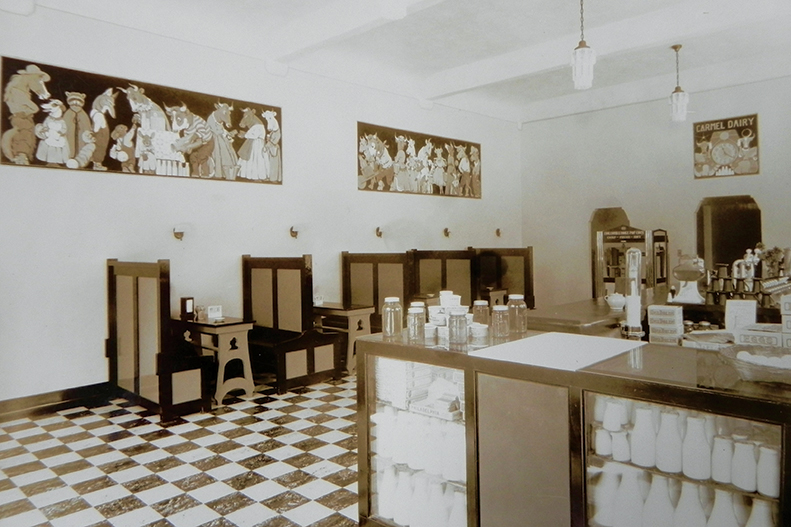
Graff’s employment of Mora to help with the decorative elements in his shop was genius. The Carmel Dairy sign, which Mora designed and hand painted, is one of only two remaining elements on the exterior of the building created by Mora. It was former mayor of Carmel-by-the-Sea Sue McCloud who is credited with insisting that the Carmel Dairy sign on the building remain visible in perpetuity.
The other visual reminder of Mora’s work for the dairy is the iron bell-shaped light sconce on the front corner of the building. Mora featured his love of animals through his depiction of two anthropomorphic cows, an expansive theme that continued inside the dairy as well.
For several generations of residents, Mora’s three humorous murals on the interior walls of the dairy created delight and lasting fond memories of this iconic Carmel establishment. Eventually, through changes in tenancy, the murals were removed from the dairy, and despite efforts to locate them, they have never been found.
Lost from daily view are numerous additional captivating artistic projects that Mora brought to the business. His work for Graff expanded in the 1930s and into the 40s to include numerous items of ephemera, including dairy menus, souvenir calendars, milk bottle decorations, milk cartons and some of the dairy’s Christmas card designs. Among these items, the glass milk bottle stands out, particularly the rare version that was decorated in color. In addition to the glass bottles, there were more common waxed paper cartons with Mora’s designs ringing the bottom of the four sides. These have become as scarce, if not more so, than the glass containers, as they were cast to the trash as disposable.
Mora’s lettering styles and creativity carried over to calendars he made for Graff. They were letterpress printed on colored paper as a promotional item from the dairy for its customers. His graphic design work also permitted him to add a short rhyming poem in honor of each month.
Upon the dairy’s closing, the building went through several iterations, first becoming a soda fountain. Then, in 1953, it became the much loved and missed Mediterranean Market, and since 2022, Palomas Home Furnishings.
The dairy building details, along with Mora’s other lasting public art in Carmel and throughout Monterey County (much of which was featured in the Winter 2025 issue of Carmel Magazine) ensures his legacy continues, especially this year—in celebration of the 150th anniversary of his birth—and for years to come.
In honor of Jo Mora’s 150th birthday, Monterey History & Art Association—in partnership with the Steinbeck Center and The John Steinbeck Library in Salinas—is holding a series of exhibits starting in October. For more information, visit www.steinbeck.org, www.montereyhistory.org and library.salinas.gov.