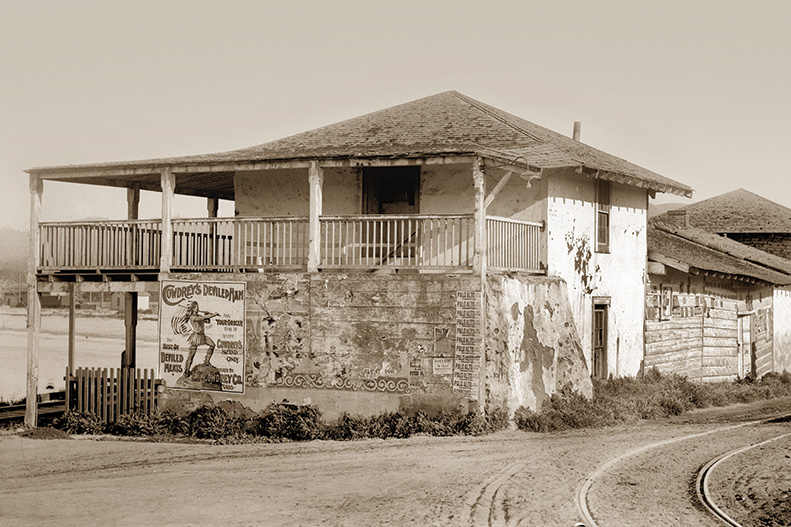
No respect—I don’t get no respect!” If Custom House could speak, the old adobe might very well utter Rodney Dangerfield’s famous one-liner to describe its place in contemporary Monterey. The building is well-preserved, and contains curated displays of trade goods common during the Mexican era. A gift shop beckons, as do engaging State Parks staff members and volunteer docents. Yet the vast majority of visitors—and locals—pass by Custom House with nary
a glance, en route to Fisherman’s Wharf or other nearby attractions. Custom House, the oldest government building on the West Coast, has a fascinating past, and played a critical role in California’s early history. The building deserves more visitation—and respect—than it currently receives.
The Spanish Era
The story of Custom House begins in the Spanish era. Monterey was founded in 1770 by Gaspar de Portolá and Father Junípero Serra, and became the Capital of Alta California. In short order, the Spanish built a structure roughly where Custom House now stands. Monterey was under strict orders from the viceroy in Mexico City not to engage in international trade. All materials were to arrive twice yearly via Spanish transport ships. The initial building most likely served as a warehouse.
Around 1814, due to mounting economic hardship, Monterey began to purchase and barter for goods with foreign ships. Around that time, the Spanish built a one-story building where the north wing of Custom House now stands. It is uncertain whether any of this Spanish building was incorporated into Custom House.
In 1818, flying the Argentinian flag, Hippolyte Bouchard and his pirate crew landed in front of this building, then dispersed to pillage and sack the City of Monterey. For six days, the Argentinian flag flew over Monterey. Thereafter, the beach in front of Custom House was named “La Playa de los Insurgentes,” meaning the beach of the insurgents. Economic duress intensified after this assault, with concomitant increased unsanctioned trade with foreign vessels.
The Mexican Era
Mexico declared its independence in 1822, and lifted foreign trade restrictions. Alta California was required to provide for all provincial government expenses via customs duties. The Aduana Maritima de Monterey (Custom House) sprung to life, collecting all duties on goods bound for Alta California. Mexican vessels paid a 10 percent tariff. Foreign vessels, coming mostly from Boston, paid a tonnage charge plus at least 25 percent (often higher) on goods sold. Ship traffic to Alta California increased under Mexican rule, from nine vessels in 1821, to an average of 22 per year in the period between 1825-1830. Foreign trade brought prosperity to Monterey—a vessel engaged in the popular hide and tallow trade might owe 20,000 pesos or more in fees. Custom House was expanded; by 1827, the first story of the north wing and the northern half of the central portion were in place.
The arrival in Monterey of a foreign ship laden with goods was a cause for celebration—both for local consumers and for government officials. On such occasions, great balls or “bailes grandes” were held at Custom House. The balls were heavily attended, with guests spilling out onto the eastern veranda, which at the time stood on the edge of a small cliff, with the bay below. Lanterns were strung outside to provide ambience and light.
In “Two Years Before The Mast,” Richard Henry Dana provides a vivid description of 1832 Monterey. “Monterey, as far as my observation goes, is decidedly the pleasantest and most civilized-looking place in California… The pretty lawn on which it stands, as green as sun and rain could make it… the adobe houses, with their white walls and red-tiled roofs, dotted about the green…”
The 1840s brought Custom House into its current configuration. In 1841, the Mexican government hired Thomas Larkin to add a second story to the north wing, and to expand the central portion of the building. Materials for the 1841 project included 5,000 adobe bricks and 8,000 tiles. Larkin was later tapped to add the two-story south wing, with work completed in 1846. Custom House, as it appears today, is a structure from the Mexican era.
The 1840s also brought renewed incursions to Monterey—this time from the Americans. Tensions were running high between the two nations and war was considered inevitable. In 1842, Commodore Thomas Jones jumped the gun by four years, and led the Capture of Monterey. The American flag was raised over Custom House. The next day, Jones got word that war had not been declared. The American flag was lowered, the Mexican raised once more, and Jones apologized and sailed off. War was finally declared in 1846, and soon Commodore John Sloat led the takeover of Monterey. A proclamation was read stating that the United States had friendly intentions and that all Californians would immediately become American citizens, with much future benefit for all. The American flag was raised—this time for good—without a shot being fired.
The American Era
Under the American flag, Custom House was initially repurposed. Lieutenant William T. Sherman took up quarters in the north wing, and the south wing was used as a hospital. Duty collection activity resumed in 1847.
After the California Gold Rush, tariff enforcement shifted increasingly to San Francisco, and Monterey Custom House revenues dwindled. In 1861, John Porter was named the final Collector of Customs in Monterey. In 1867, Monterey was closed as a port of entry and Custom House was shuttered.
In the decades that followed, Custom House was subject to vagrancy. Captain Thomas Lambert was appointed as custodian, a position he (and his wife Sarah) held for 33 years. Early on, Lambert bought a nearby lumber mill, which helped him keep Custom House in reasonable repair. Disappointed with the mill foreman, Mrs. Lambert took over operational control to good effect. She boarded up the porches on the south wing to create additional rooms. The family cow was stabled where the gift shop now resides. Mrs. Lambert planted four cypress trees to the east of Custom House. Two survive today—plumed “Don Gaspar de Portolá” and solemn “Commodore Sloat.”
Despite the Lamberts’ best efforts, Custom House fell into decline—mirroring the overall condition of the forlorn pueblo of Monterey. In 1879, Robert Louis Stevenson lived for several months in Monterey. In “The Old Pacific Capital,” he describes Monterey as “…a place of two or three streets, economically paved with seasand, and two or three lanes, which were water courses in the rainy season… Short sections of wooden sidewalk only added to the dangers of the night…”
In 1889, Charles Crocker decided to extend his Southern Pacific Railroad from his Hotel Del Monte terminus to his sand operation just beyond Pacific Grove. A roadbed was created to the east of Custom House, burying La Playa de los Insurgentes. Railroad tracks were laid within mere feet of Custom House. In 1890, trolley tracks were placed on Alvarado Street, to the immediate west of Custom House. Initially horse-drawn, the trolley was electrified in 1903.
At the turn of the century, the Native Sons of the Golden West (NSGW) resolved to restore Custom House. NSGW arranged to lease the building from the Federal Government for a dollar a year, then transferred the lease to the state, and secured restoration funding through the California State Legislature. Work occurred in 1901 on the central portion. Artists Charles Rollo Peters and Charles Dickman were brought in as consultants to ensure historical accuracy. Additional state-funded work occurred in 1917. By 1930, a museum had been created in Custom House, and the state opened the doors to the public. In 1938, the state purchased Custom House from the Federal Government. Half of the purchase money came from community members.
In 1970, the environment surrounding Custom House took its present form. In a four-year urban renewal project, Custom House Tunnel and Plaza were built, and parts of various streets were removed to create the space where the Conference Center and Portola Hotel now sit. That same year, the museum was re-curated to its current presentation.
In the late 1870s, artists began visiting Monterey in numbers; many took up residence. Although landscapes were the principal genre back then, for many decades, artists often painted Custom House. The list of Custom House painters is long and includes Lester Boronda, Harry Stewart Fonda, Christian Jorgensen, Bertha Stringer Lee, Pedro de Lemos, M. Evelyn McCormick, Jo Mora, Mary DeNeale Morgan, Charles Rollo Peters and Manuel Valencia. Many of their works are on permanent display at Casa Serrano in Monterey, Trotter Gallery in Pacific Grove, and elsewhere. The artworks are a testament to the past importance of Custom House.
The next time you are in the area, consider paying Custom House a visit. Imagine the building in its various eras and uses, and in its various states of construction and repair. Imagine the human activity in and surrounding the building as it passed through the decades—the people, their affairs, the languages, the dress. Chances are you will depart with a sense of awe—and respect.
Custom House is located at 1 Custom House Plaza in Monterey, and is open Tuesday through Sunday from 10:00 am to 5:00 pm.