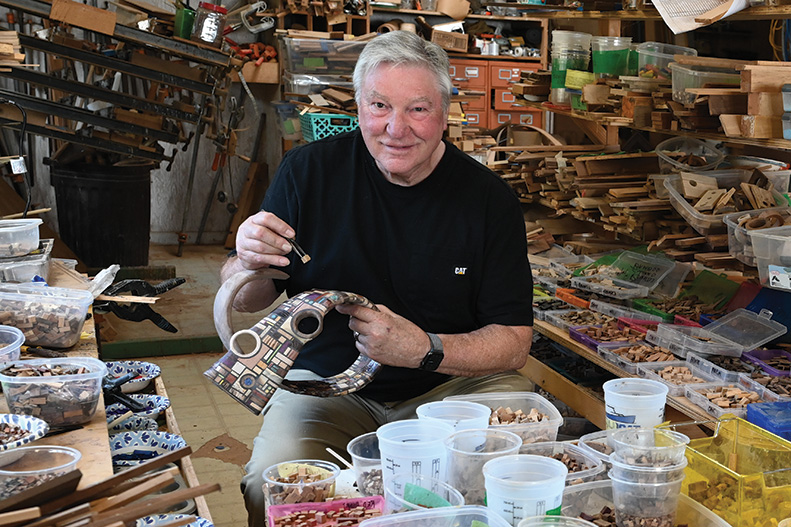
One day, thousands of years ago, one of our human ancestors discovered that the wooden branch of a tree could be shaped using a sharpened tool. Obviously, that precise date is lost to time, but what is known is that over the millennia, humans have used this extremely versatile material to craft a myriad of objects ranging from the rudimentary to the sublime. Wood artist Craig Lauterbach has taken the craft of woodworking to an entirely different and incredibly creative realm.
The exquisitely and intricately designed and crafted pieces depicted on these pages represent the culmination of decades of experimentation. “I’m completely self-taught, and have no art background,” Lauterbach says. “My work is the result of trial and error—a lot of error,” he adds with a laugh. Clearly, he’s improved on his errors immensely. His art is in a class by itself.
A Wisconsin transplant, Lauterbach came to California for college in 1966. Just out of school, he and his wife Regena relocated to Monterey, and he purchased his first tool, a table saw. With that humble beginning, he started doing cabinetry work and then designing and crafting some furniture pieces, such as beautifully designed and carved coffee tables and mirrors. Soon, he turned to making functional art pieces.
Lauterbach’s capacious workshop, built in 1992, is filled with every woodworking power and hand tool imaginable. There are works in progress and seemingly abandoned projects lying everywhere, along with an encyclopedic collection of exotic wood species. Leopardwood, Australian lacewood, koa, wenge, padauk, ambrosia maple and many others—including native Monterey Peninsula woods from his own property—neatly line a wall, awaiting the magic hands of this master artist. At first glance it may seem disorganized, but Lauterbach can immediately put his hands on the texture and grain of material that exactly meets the vision he has for the piece he’s working on.
A workbench next to a large window is surrounded by plastic bowls filled with the tiny pieces of wood, gems and other objects he uses in his designs, along with small tools that would be perfectly at home in a dentist’s cabinet. Here, he pieces together the designs that are affixed to the fanciful organic shapes that are initially formed with veneers of yet more rare woods. They are then sanded, smooth and affixed with an epoxy resin mixed with sawdust. “Different woods age, expand and retract at different rates due to humidity and temperature,” he explains. “The resin seals them and prevents movement.”
Like Colonel Sanders’ 11 herbs and spices and the recipe for Coca-Cola, Lauterbach’s precise methods are closely guarded secrets. “I was asked to do a symposium in Chicago for several hundred woodworkers,” he recalls. “I was asked to demonstrate exactly what I do. But when you’ve spent 30 years figuring out how to do something, you don’t exactly want to tell the world about it. One guy said, ‘I’m going to go home and copy you.’ I wished him luck,” he says. The artist isn’t at all arrogant about his work—he’s a kindhearted and friendly soul—but after all, it’s understandable that after putting so much work into his techniques, he’s definitely earned the right to keep them under his vest.
Lauterbach’s work is available at the Carmel Art Association on Dolores between Fifth and Sixth in Carmel. For more information, visit www.craiglauterbach.com or www.carmelart.org/artist/craig-lauterbach.