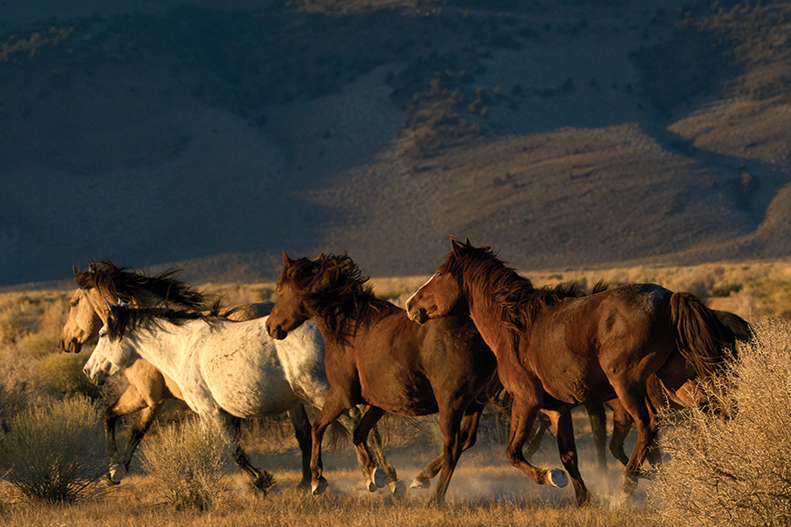
They’re majestic, with silky manes flowing freely in strong breezes. DNA suggests they are descendants of horses that roamed the West more than 12,000 years ago. They exist in a place where only the strong survive, in conditions ranging from snow drifts to scorching heat. Hours southeast of Carmel, where the meadows meet the mountains of the Eastern Sierra, a herd referred to as the Montgomery Pass Wild Horses makes the landscape even more surreal. But in July, as many as 500 of them are on a schedule to be rounded up and transported to alternate areas by two governmental agencies, the Bureau of Land Management (BLM) and the U.S. Forest Service. The agencies cite overpopulation and possible hazards to motorists as just two of the reasons for the massive undertaking. But critics call the plan a travesty and say horses will die from trauma during the roundup or transport, or worse—end up in the hands of the slaughter trade. Indigenous tribes based in the area, where these horses have existed for generations, are at the forefront of making sure this doesn’t happen. They’re being assisted by activists and artists based in Carmel.
In May, Patricia Qualls Contemporary Art Gallery will host a photo exhibition of these beauties by Canadian wildlife photographer Marni Grossman titled, “Free and Wild: Horses of the Numu” (“numu” means “the people” in the Paiute language). The exhibit will assist a new nonprofit, the Indigenous Wild Horse Society, to help fight the plan to uproot the herd. “They’ve always lived here as long as we can remember,” says Rana Saulque, vice chair of the Benton Paiute Tribe, located in proximity to the horses. “We have a lot of oral history and stories about how our people used them and maintained them. They were part of the family, part of our everyday life. We see them as our ancestors.”
Mono Lake Tribal Representative and Cultural Monitor Ronda Kauk agrees, “I see them, and my family and my children see them, as a connection to the land and our home and the spirit—and the sacred world between us and that. It’s so important because we’ve lost a lot of our culture, but they still keep us grounded and help us remember what it’s like to be a family.”
With their equine family members’ wellbeing at stake, outsiders have stepped up to help Saulque, Kauk and other tribe members with their fight. Carmel’s Nico Georis and his mother Sheila Georis are two of them. Drawn to the remote Eastern Sierra years ago, Nico credits his moving and remaining there to the spirit of the Indigenous people and the hundreds of wild stallions and mares that have become part of his own journey.
“I’ve never seen horses being horses until this,” Nico says. “It’s an incredible untold story of wild horses and Indigenous people on Yosemite’s doorstep.” Nico ended up connecting with Indigenous people during protests against BLM projects, and it didn’t take persuasion to get his mother Sheila involved. “The instant he told me, my heart was called in,” she says. “You cannot argue with the heart and mine moved forward.”
Serendipity occurred when Sheila, who was scheduled to meet tribal leaders and observe the horses, was expecting a visit from her friend, one of Canada’s most renowned photographers, Marni Grossman. Together they, Nico, and the Tribal leaders made what ended up being a sacred trek. “There were literally hundreds of them coming from every direction,” Grossman says excitedly of the horses. “We were in the middle of this open area. You could see them coming because you could see dust flying up in the distance. I said to Ronda, ‘That was the most extraordinary experience I think I’ve ever had, to be in the wild with 150 or 200 wild horses, just being in their environment.'” One of Grossman’s guides, Ronda Kauk, told her that usually they’d only see a few, maybe up to a dozen, horses. Grossman, who works on major movie productions as a set photographer, but prides herself on her stunning wildlife photography, says she was gobsmacked when it happened for a second time two days later. “This band, they circled around and around, then they went by us and took off. When they left, we were all crying and hugging each other…We think it had to do with their energy and our energy being in a collective.”
Sheila also says it was unreal. “You look into these faces and these eyes, and they are ancient and they are so beautiful and so full of intelligence. They embody and allow us to actually feel the spirit of freedom. It’s exhilarating, it’s very magical to be out there with them!”
Grossman and Sheila Georis edited almost 6,000 shots down to 200 in a months-long labor of love. The photographic results are gorgeous, showing everything from skirmishes to nuzzling, galloping to grazing. But Rana Saulque and Ronda Kauk say even these exquisite pictures can’t encompass the real-life impact of the buckskins, sorrels, grays, palominos and duns. “I always like to say my favorite color is wild,” Saulque says. “They have the most amazing colors, shapes and sizes. Some are tall. Some are short. They have the coolest little personalities. Just to sit out there, you lose track of time because being out there is a feeling—being around them is so special.”
Kauk soaks in the many lessons they offer. “After having my kids, I had an autoimmune disease and my skin started changing and my kids would always say, ‘You’re beautiful.’ And then I would see the horses in different color skins, and they were like, ‘See mom, you’re beautiful like them!’ All the colors are beautiful.” She is emotional when describing their influence. “It’s hard to tell how we feel about them because you have to be here to experience it. Their hooves are the heartbeat for us here, and they breath the same air as us.”
Those fighting the upcoming roundup are everything from perplexed to furious with the government’s plan. Indigenous leaders want the horses left where they are and placed under their care. “We want a seat at the table [with government agencies]. We have a management plan, and they haven’t been managed,” Rana Saulque says.
Nico Georis emphasizes that his Native American “neighbors” know more than anyone else about what must be done. “These folks hold the key to how to take care of the land. The concept of wilderness is like a slur to them—like having a child and not combing their hair.”
Ronda Kauk says they plan to manage the herd as closely as possible to the way their ancestors did. “We want to take care of the land from what we learned from the past until now. And, to prevent the animals from harm: roundups, displacements, slaughter pipelines, loss of habitat, and them not being treated like a problem—but like a present.” To all involved, it’s vital that the Indigenous representatives are respected and listened to most. “We got a second chance to have our voices heard for our ancestors,” Kauk says. “For some reason, it’s coming to us and to other people who are interested to say: ‘We need to speak up. We need to be a voice for the horses.’ It’s scary, but we’re willing!”
Gallery owner Patrica Qualls says her efforts to be part of that voice are but a drop in a huge bucket. “For me, it’s how can we open our hearts and scrape the barnacles off our hearts? What can we do to make a softer, gentler world?” She, too, emphasizes that the tribes need to be in charge. “Imagining these horses that have walked on that wild land for many generations, to think that they may be moved and put in transport and broken…anything could happen once they leave that land. If they don’t have these guardians, those little spirits can be broken.”
Qualls, Grossman, Sheila Georis, Saulque and Kauk, are donating their time, talents, and valuable gallery space to raise money for the Indigenous Wild Horse Society, which is thought to be the only Indigenous run group of its kind. “This nonprofit is not about prevention—it’s about not regretting,” Kauk says.
Qualls ensures attendees will have no regrets seeing these photos—they will be life changing. “Come with like-minded, open-hearted people and let’s gather in a circle of good people who care about innocent beings.”
“Free and Wild: Horses of the Numu” will be shown at the Patricia Qualls Gallery (located on Dolores Street between Fifth and Sixth in Carmel) from May 1-8. A Variety of events will take place during the week. To learn more or to donate, visit www.patriciaqualls.com or www.indigenouswildhorsesociety.com, and to see more of Grossman’s images, visit www.freeandwild.org.