Anyone who has driven U.S. Highway 101 has certainly noticed the weathered bells, suspended on shepherd’s hook-shaped stanchions, spaced roughly a mile apart in many areas. They’ve been a fixture of the road for generations and mark what is known as California’s El Camino Real (meaning The King’s Highway or The Royal Road), stretching northward from Mission San Diego de Alcala to Mission San Francisco Solano in what is now Sonoma.
There are a few bells mounted on roadsides around the Monterey Peninsula as well, notably on the Rio Road median in front of the Carmel Mission, and on the lawn in front of Colton Hall and outside the Cooper Molera Adobe, both in Monterey. They’re popularly known as the Mission Bells. They’re a long-time fixture of the scenery and most people assume they are somehow tied into the Spanish Franciscans who founded the chain of 21 missions along the spine of the state between 1769 and 1823. But the story of their origin is a much newer one.
True, following the bells will lead a traveler to the general locations of the missions—El Camino Real roughly follows the route the Spaniards used to travel between the missions and diverges from U.S. 101 several times, as evidenced by their peninsula locations—but it wasn’t a roadway pioneered by the Spanish to accommodate travel between those settlements. The Europeans mainly followed foot paths established by indigenous peoples hundreds, if not thousands, of years prior to their arrival.
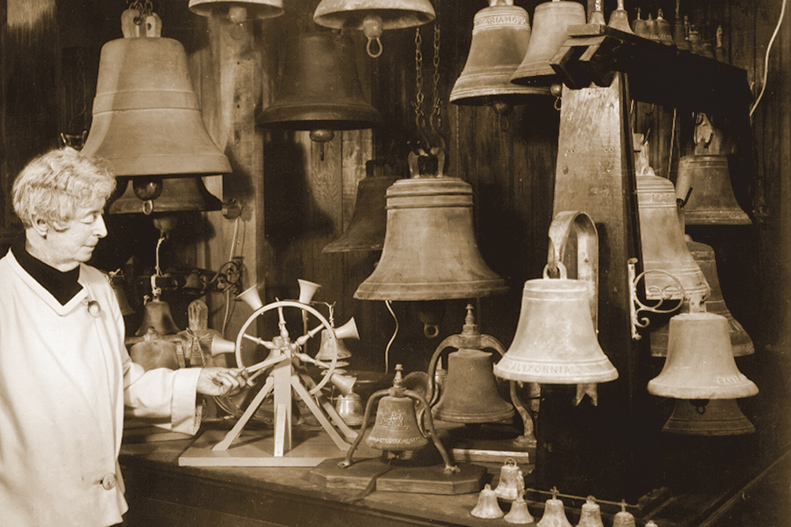
The Spanish Revival movement of the late 19th century sparked renewed interest in all things Iberian, particularly architecture, especially in Los Angeles. Pasadena resident and history buff Anna Pitcher launched a campaign in 1892 along with Los Angeles Public Library Head Librarian Tessa Kalso to promote and preserve the route of El Camino Real and create awareness of the sad state of the missions they loved. The initiative was embraced by the Native Daughters of the Golden West, the California Federation of Woman’s Clubs and, perhaps most enthusiastically, by the Automobile Club of Southern California. Author, historian and preservationist Harrye Rebecca Piper Forbes was also passionately interested in saving the deteriorating missions and joined in forming the El Camino Real Association of California in 1904. She designed the bells we see today to be placed as mile markers along the route and created The California Bell Company to produce them. The first bell was installed at the Plaza Church on Olvera Street in Los Angeles on August 15, 1906.
Original mission bells are cast iron, measure 18 by 18 inches, weigh around 90 pounds, are mounted 15 feet above ground and are inscribed with “1769 & 1906” on the side and “El Camino Real” on the skirt. The El Camino Real Association placed more than 400 bells along the route between 1906 and 1914. By 1960, fewer than 100 remained, victims of theft, highway construction, collisions and just plain neglect. At one point, in an effort to deter theft, replacements were made of concrete. The California Department of Transportation (Caltrans) has long been charged with their maintenance and replacement.
Today, The California Bell Company is based in Saratoga and is owned by real estate broker John Kolstad. “I wanted to purchase a bell for my home and tracked down the company’s owner, Joe Rice.” Rice acquired the business in 1955, closing up shop in the early 1960s. “Joe told me he wouldn’t sell me one bell, but he would sell me the company, and I bought it in October 2000.” The sale included molds, equipment, vintage photo and several original bells. Kolstad found he had enough to continue making new bells, and that led to a contract with Caltrans to produce replacement bells. “They are delivered bright and shiny and quickly attain the patina we’re all used to seeing.” California Bell Company produces a range of bells, including replicas of the Mission Bells for sale to private individuals. The firm also forged the bell that hangs from the World War I memorial arch in the median of Ocean Avenue at the corner of San Carlos Street. More historical information on the company is online at www.californiabell.com.
This chapter of California history is not without controversy. Nathan Masters, host and producer of Lost L.A., an award-winning KCET series says, “The message implied by the presence of the Mission Bells—that motorists’ tires trace the same path as the missionaries’ sandals—is largely myth.” And indigenous people of Alta California have been working for their removal, seeing them as unwelcome reminders of the harsh treatment their ancestors were subjected to by the missionaries. The last of three bells located in Santa Cruz was removed in 2020 by order of the city council after years of lobbying by members of the Amah Mutsun Tribal Band.
In the 21st century, California’s unique Mission Bells mean different things to different people, and as such reflect the rich cultural diversity of the state. It’s true that they were created as a marketing scheme, a way to sell automobiles, the gasoline that powers them and indeed, the then-nascent hospitality industry as a whole. But they’ve become part of the fabric of everyday life in the nation’s most populous and prosperous state and are beloved by many, not for their controversy, but for their nostalgic nature and firm place in California history.