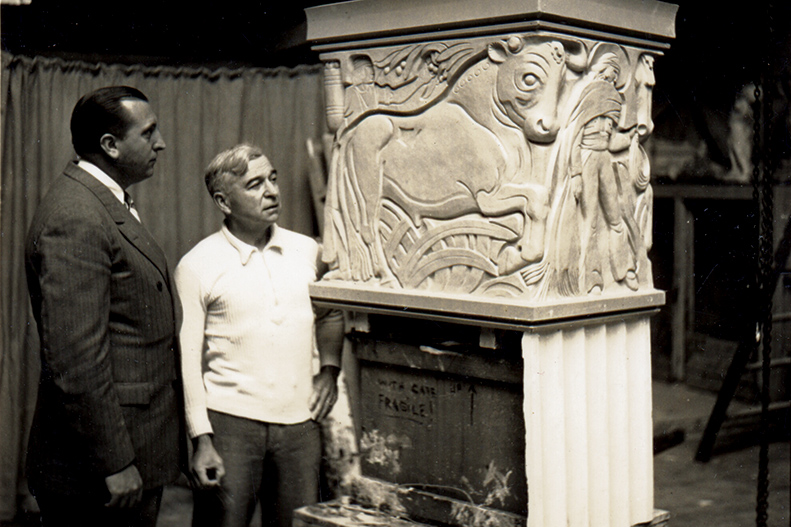
There are numerous cultural threads to follow both historically and artistically throughout Monterey County. One such thread involves tracing the artistic accomplishments of Joseph “Jo” Jacinto Mora (1876-1947), perhaps the most interesting artist and writer you may have never heard of. His art in public places still exists throughout Monterey County, from the southern part to its northern reaches, and out west to the coast.
On October 22, 1876, Mora was born in Uruguay to a classically trained Catalonian sculptor father and a French-born mother. The family moved to the Eastern U.S. when Mora was very young. After attending several art schools on the East Coast and working as an illustrator and cartoonist in the Boston area, Mora spent the rest of his adult life living and working in the Western U.S., the last 27 years of which were in Carmel and Pebble Beach.
In 1920 Mora found himself—along with his wife and two children—moving to Carmel from the San Francisco Bay Area to work on what he later regarded as his most significant masterpiece—the Father Serra Cenotaph in the Memorial Chapel at Mission San Carlos Borromeo del Río Carmelo. But the cenotaph was just the start of Mora’s work in Monterey County.
Mora’s artistic gifts range over a wide variety of mediums, including drawing, painting, illustration, cartooning, sculpture, photography, mapmaking and writing; the diversity of which is an amazing accomplishment for one person. Wonderful examples of his work are on display throughout Monterey County and tracing the trail has never been easier, thanks to the advent of the internet. Throughout this article, place names in italics can be used to initiate a search to bring you to the location of an example of Mora’s work.
Beginning in the South County town of King City you can view the decorative elements of one of Mora’s most significant achievements, the Robert Stanton Theater. Initially built for—and still functioning as—the King City High School Auditorium, this building was designed by Jo Mora’s neighbor and friend, architect Robert Stanton. It was the second building the pair worked on together and both projects were Work Projects Administration (WPA) efforts, completed between 1937-1940. Both buildings have since been added to the National Register of Historic Places.
In both cases, Stanton gave Mora free reign for the decorative elements on the buildings. In the case of the Robert Stanton Theater, Mora created the bas-relief adornments on the front of the building, column caps on the sides, and the door plaques to represent the fine and performing arts with a variety of cultural acknowledgements reflecting his own interests.
Travel north from King City to Salinas via River Road, Metz Road/Old Stage Road or Highway 101 and, in the heart of downtown Salinas, you’ll find the Historic East-West Building of the Monterey County Courthouse.
The vision for this project was also the work of architect Robert Stanton. Stanton’s approach was to create a building in a Classic Moderne style with elements of the International style. One of the requirements of the WPA program was that building designs include artistic decorative elements for which Stanton turned to Mora.
Stanton’s monolithic design provided the perfect canvas for Mora’s artistic efforts. The various surfaces, from the doors to the column caps, provided areas for Mora to craft images which tell the story of Monterey and California history alongside an image of Justice on the east exterior.
Sixty-two three-dimensional sculpted heads are located on the building’s spandrels between the first and second story windows. These sculptures continue, evenly spaced, around both the exterior and on the interior courtyard of the building on all but the west side. The busts represent 23 people in California history—some specific, some archetypal—including “Indian Man” and “Indian Woman,” Junipero Serra, Juan Cabrillo, John Fremont and “Pioneer Man” and “Pioneer Woman.”
On the north side of downtown Salinas is the California Rodeo Heritage Collection Museum. Inside is an original print of the “Sweetheart of the Rodeo/Evolution of the Cowboy” poster Mora created for the rodeo committee in 1933. His depiction of the story of the American cowboy has been in print ever since and is Mora’s most widely known work of art.
Traveling west to the peninsula by Highway 68 brings you to the Naval Post Graduate School (access by appointment only). The former Hotel Del Monte is the setting of Jo Mora’s half life-size “La Novia” diorama, completed in 1940.
Downtown Monterey and Old Fisherman’s Wharf offer several sites of interest to those seeking the legacy of Jo Mora. The Monterey History and Art Association (MHAA) collection features material related to Mora at Stanton Center, which houses the Jo Mora Collection; at Casa Serrano, which has a wonderful display of original art by Mora, much of which was donated to or purchased by MHAA directly from the Mora family; and at the Mayo Hayes O’Donnell Library where there are items related to Mora available for perusal.
On Forest Avenue in nearby Pacific Grove, you’ll find the mesmerizing Trotter Galleries Pacific Grove Museum-Gallery. Owners Terry and Paula Trotter celebrate and educate the public about the artistic history of California with an emphasis on local artists, including Jo Mora. One of many Mora-related displays includes seven original murals of anthropomorphic animals Mora created for the Fable Restaurant in San Francisco’s Hotel Drake-Wiltshire in 1936.
Next, follow Holman Highway (Highway 68) to Carmel. Carmel priest Ramon Mestres, an admirer of Mora’s work, commissioned Mora to create the Father Serra memorial, a bronze and travertine cenotaph for the Memorial Chapel at the Carmel Mission, along with a cross and altar, that were dedicated on October 12, 1924. Mora considered the cenotaph to be his supreme artistic accomplishment.
Upon moving to Carmel, Mora immersed himself in a variety of aspects of community life. He was an avid member of the Abalone Softball League in the 1920s, and he starred in the leading role of “The Bad Man,” a play at the Forest Theatre. Mora was also a founding board member of the Carmel Art Association in 1927.
Concurrent with his work at the Carmel Mission, Mora carved a wooden Junipero Serra statue and built a shelter and benches in the Spanish Revival style at the intersection of Camino Del Monte, Dolores and Alta streets in Carmel—a commission for S.F.B. Morse, for what was to be the gateway to Morse’s residential subdivision—Del Monte Properties (Pebble Beach). The landmark was dedicated in 1922 (the statue is currently off site, but the shelter and benches still stand).
Earl F. Graff, the proprietor of the Carmel Dairy, hired Mora, and often bartered with him to help with the decorative elements in his shop on the corner of Ocean and Mission. A lasting reminder of Mora’s work there is the exterior light sconce with two cows which hangs on the corner of the building. If you view the building from across the street, it is certain to remind you of an old-fashioned milk bottle.
Both branches of the Carmel Public Library contain Mora’s ephemera, including “Carmel Dollars” and “cartes” (or maps). Mora is probably best known for his series of cartes—15 historically accurate, humorous maps, made between 1926 and 1945, that include depictions of Carmel-by-the-Sea, 17-Mile Drive and the Monterey Peninsula.
The last stop on our journey is the 1928 sculpture Mora created for L. C. Merrell’s arcade in Carmel’s El Paseo Courtyard of a bowing/curtseying couple in typical early California dress, created as an ode to early California history.
Mora’s legacy is strong here—if you know where to look—and driving throughout beautiful Monterey County will expose you to new people and places while experiencing the incomparable art of Jo Mora, which is still such a vital part of the community and county he loved.