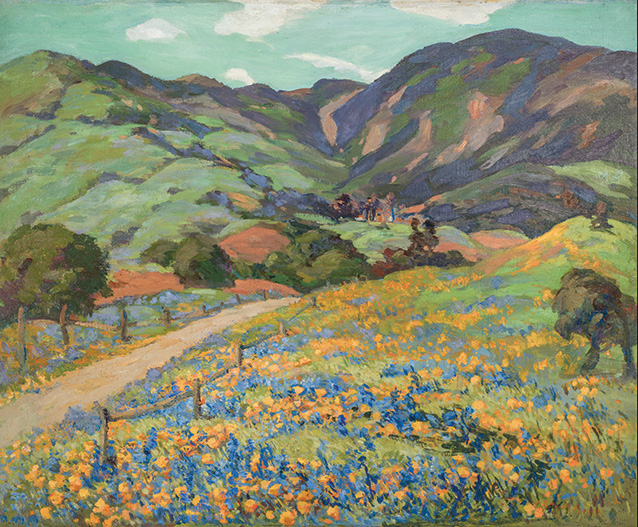
In the first half of the 20th century, Mary DeNeale Morgan (1868-1948), a California native, became a seminal figure in the founding and development of the Carmel art colony. She established venues for the exhibition of regional artists, taught regular art classes, and habitually donated her time and paintings in support of the peninsula communities. In 1927, she became a charter member of the Carmel Art Association. What distinguishes her today, as it did during her lifetime, is her art. Ranging from contemplative tonalism to a vibrant post-impressionism, her paintings were immensely popular with art collectors and museums.
It has been argued that Morgan abandoned her comfortable upper middle-class life and the many cultural advantages of the San Francisco Bay Area to settle in the village of Carmel-by-the-Sea solely to paint amid the inspiration that the dramatic coastal scenery provided. Yet dozens of professional artists seasonally traveled to paint in Carmel and returned to their homes in the Bay Area. Her reasons are far more complex and are based on the discrimination quietly endured by women artists. Art education for women was seen as a mere hobby in preparation for a suitable marriage. Her hopes that the fledging art societies in Oakland, Alameda and Berkeley would provide all artists with equal opportunities to exhibit were soon dashed when those organizations collapsed due to internal dissention. Constant pressure at home to accept a husband and quiet domesticity among the respectable widowers entertained by her father proved untenable.
Carmel not only provided an escape and stunning scenery, but the opportunity to build an egalitarian art colony from scratch, one shaped by the mistakes of the past. This is precisely what Morgan did—with clear vision of purpose and immense determination—when she moved permanently to Carmel at the age of 42 in 1910. When the vast majority of female painters depended heavily on family support, she maintained her independence solely from the sale of her art. She reorganized and expanded the Carmel Arts and Crafts Club into a destination where all of the regional artists, and many from the Bay Area, sought to exhibit. Her formal art classes at that club grew in popularity, with attendees coming from several Western states. Through her managerial skills and volunteer work she helped to guide the art community in Carmel from its humble beginnings to a position as the largest and most important art colony on the Pacific Coast.
Morgan’s own artistic career changed fundamentally with her attendance at the 1914 William Merritt Chase Summer School of Art in Carmel. Chase persuaded her to adopt a brighter palette, to find unconventional subjects, and to paint emotionally with “impasto” using not only a brush, but a knife. As this transition gained momentum, her subject matter became more diverse and her palette, in some instances, bordered on the flamboyant. Morgan’s fussiness was replaced with pronounced displays of light, the use of unmixed colors and the elimination of unnecessary detail. When her art was exhibited at distant venues, it was assumed that Morgan, who signed her first name with the initial “M” was a man. From the mid-1920s to the late 1930s no female artist in Northern California exhibited more paintings annually at professional art associations, commercial galleries and museums than Morgan.
There are two major impediments hindering the evaluation of her persona and art. The first is Morgan herself, a very private person. The largest collection of the artist’s papers, which are currently in the archives of Monterey Museum of Art and the Oakland Museum of California, consist almost entirely of newspaper clippings of her exhibits and formal correspondence relating to the shipping of her art from one venue to another. An interview with her sister and short “histories” by members of the Morgan family shed few insights into her character. The second impediment is the lack of any clear linear evolution in respect to her style after 1914. This has annoyed modern art historians who search for “developmental stages” to neatly catalogue an artist’s creations. From the mid-1920s through the mid-1940s Morgan’s eclectic approach, which entertained her contemporaries by mixing radically dissimilar styles of art in a single exhibition, ranged from tonalism and an unpretentious realism to techniques similar to the European impressionists and post-impressionists. She never adopted the tenants of abstract or non-objective art, finding them too deceptive. An additional hindrance to any assessment is that her work, with only a few exceptions, is never dated and the same paintings at different exhibits may carry different titles. Consequently, the surviving narrative on the “private” Morgan is primarily a recitation of the rare interviews with critics at her exhibitions or in her Carmel studio.
Much of Morgan’s early fame rested on her embrace of subjects along the rocky coast, which included the “weirdness” of Carmel’s trees, deformed by the relentless forces of wind and rain. These renderings were not snapshots of cruelty and decay, but psychological studies of survivors—spirits tranquilly holding steadfast to the principle of sustaining life. Her paintings were never minor variations of a single theme, like the clinical observations of mutating light in Monet’s haystacks. Nor did she attempt to establish, by the repetition of subject matter, an iconography of arboreal life. Instead, they were self-portraits of her own ever-changing moods, rendered in a broad vocabulary of earth tones or bright colors and in perspectives that ranged from peaceful to unsettling. She was an authentic “impressionist.” Throughout her entire career she refused to discuss her creative process, implying that it was a mystical experience. It was the pronounced surreal quality of some of her cypress trees that led George Bellows and Salvador Dalí, during their visits to Carmel, to seek her advice on where to find the most “fantastic scenes.” Morgan never abandoned those peculiar trees as a subject, and a Pine Cone article from 1931 reported that she would “stick by her cypresses until they sink into the sea.” She also painted domestic and public architecture, but only a few portraits, primarily profiles.
Her art developed with the times and was embraced by Carmel. The intellectual climate of her village, which included an eclectic literary and political mix of resident socialists, communists and reactionary conservatives, as well as summer visits by many American and European avant-garde painters, fostered the cultivation of new forms in art. Unlike many painters who settled for the mundane after financial success, she learned to search within herself for new avenues of artistic expression.
From April 30-August 16, Monterey Museum of Art is offering the first comprehensive retrospective of Morgan’s art since a 1944 Stanford University exhibition. For more information, call 831/372-5477 or visit www.montereyart.org.