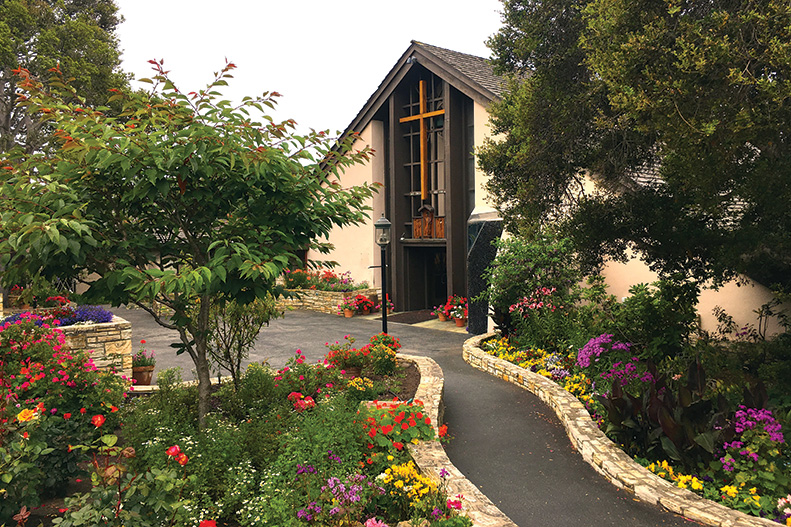
Among the artists and scholars living in Carmel in the town’s earliest days, there were enough Episcopalians to warrant local services by 1906. Initially, services were led by visiting clergy at the Pine Inn with a congregation anchored by such luminaries as artist Mary DeNeale Morgan. In a few short years, that congregation formalized into All Saints’ Episcopal Church.
For those unfamiliar with Christian sects, the Episcopal Church’s origins lie in the Church of England, splitting away after the American Revolution. Since that time, quite notably, a quarter of all U.S. presidents have been Episcopalians, starting with George Washington.
Episcopalians have long been known as a fun-loving bunch. In fact, there’s an old saying: “Where four Episcopalians are gathered, you’ll find a fifth” (of bourbon, preferably). While that may not always be true, it is a testament to the good humor and affability of Episcopalians and of the All Saints’ community. Perhaps All Saints’ most famous embodiment of this spirit lies in artist Eldon Dedini (1921-2006), whose comics graced the pages of Esquire, The New Yorker and Playboy as well as All Saints’ “Portly Padre” cookbook. Episcopalian open-mindedness applies to more serious matters as well. Since 1976, Episcopalians have ordained women to the priesthood and heartily welcome everyone regardless of sexual orientation as well as within the clergy.
All Saints hired M.J. Murphy, father of Carmel architecture, to build their first real home on Monte Verde between Ocean and Seventh (now Carmel City Hall). The charming wood-shingled church was dedicated in 1913, when Carmel’s population was just 550, and housed All Saints until the congregation outgrew it in the late 1940s. Following the Second World War, returning servicemen, who had visited Carmel while stationed at Fort Ord, settled in the area. By 1950, the population had grown to almost 4,400—Carmel was suddenly filled with families and children. Under the leadership of the church’s young priest, the Reverend Al Seccombe, a new church building was planned for the booming congregation, and in 1947, All Saints purchased a two-acre property at Dolores and Ninth. A modern design to reflect the unique spirit of Carmel was selected with a price tag of $225,000. Funding was secured through donations from the congregation and the community, most notably through the generosity of parishioners Marcia and George Hart of Pebble Beach. In fact, Marcia Hart also purchased a home on Atherton to serve as a rectory for the Seccombe family. Mrs. Seccombe was heavily pregnant at the time and Mrs. Hart ensured the home had all the conveniences an expectant mother would need, including a brand-new electric freezer stocked with choice cuts of meat. Upon arriving at their new home on moving day, the Seccombes were flabbergasted to find the impeccably dressed Mrs. Hart in the bathroom on hands and knees scrubbing a spot that the cleaning crew had missed, just one example of many selfless gestures she made for the church and its community. Thanks to the Harts’ generosity, an endowment made 75 years ago continues to help support the church today.
The Carmel architecture firm of Robert Jones was hired to design the church, with Charles Symonds (a member of All Saints) as lead architect. Other notable local projects by the firm include the Smithsonian award-winning design of the Monterey Airport and Bing Crosby’s Carmel Youth Center.
The most recognized name related to the new building’s decorative arts is that of Alec Miller. The Scottish sculptor and master carver’s works are installed in important churches throughout the U.K. and the U.S. All Saints was one of Miller’s last commissions, and his work can be seen in the beatific carvings throughout the church. Miller worked closely with local woodworker and artist Ivor Prosser, who built the church furnishings.
The luminous stained-glass windows were designed by Willemina Ogterop of Berkeley, the principal designer of Howard Cummings Studio from 1928 until her retirement in 1953 at the age of 72. Ogterop’s designs can be found throughout California and in nine other states, including such notable churches as the Presidio Chapel and St. Ignatius in San Francisco.
The new church opened its doors for its first service in February of 1951, and the congregation was more energized than ever. Mike Raggett (a member since 1946), whose father ran the general dry goods store, Putnam & Raggett on Ocean, remembers particularly how he felt looking at the church’s “large and beautiful stained-glass windows.” Raggett served as an acolyte and was often in trouble for not genuflecting or for miscounting communion wafers. He remembers the delight of walking home to Camino Real after the service, relieved from duty, enjoying the countryside.
Longtime church members fondly recount tales of All Saints’ renowned Dickensian Dinners, organized with the bonhomie of Eldon Dedini and man-about-town Hans Lehmann (a member since 1939) who served as maître d’ in tails, playing his concertina amongst the crowd in the parish hall. The annual holiday event drew hundreds, necessitating three seatings over the course of the night. Everyone came, everyone dressed up and most stayed afterward to clean up.
Over the years, the church hosted fashion shows, talent shows and spirited auctions and was well known for its incredible rummage sales. Joyous wedding parties and other celebrations continue to fill the parish hall with music, the clinking of glasses and the echo of laughter.
Through various eras of church leadership, All Saints’ dedication to the community has led to the organization of numerous institutions, including St. Dunstan’s and All Saints’ Day School in Carmel Valley, St. Matthias in Seaside, York School in Monterey and Santa Lucia at Big Sur, where the church has long provided land—free of charge—for Big Sur Health Center’s home.
Today, under the leadership of Rector Amber Sturgess, All Saints continues to support the community through outreach (I-HELP homeless ministry, the Thomas Carman Food Pantry with Epiphany Marina and many other nonprofits) and to engage and inspire through spiritual groups (weekly Centering Prayer, book club and various courses and retreats throughout the year, and ministry to guest musicians, including the Bach Festival, I Cantori and Madregalia).
120 years after the church’s first service, All Saints will commemorate the 75th anniversary of its “new” church, with a jubilee celebration on Sunday, July 26, at 4 p.m., featuring the unveiling and dedication of artist Elizabeth Barlow’s painting, “Transfiguration,” entertainment by Bach Festival musicians and an afternoon tea.
For more information, call 831/624-3883 or visit www.allsaintscarmel.org.