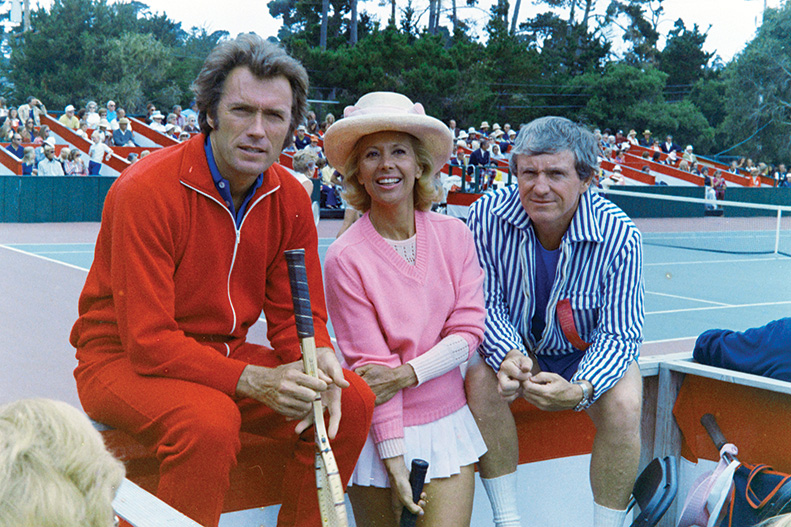
Tennis championships on the Monterey Peninsula started before golf was even played here. In an 1894 championship, Charles Hubbard and Harry N. Stetson defeated brothers Robert and George Whitney on Hotel Del Monte’s grass court in a hard-fought doubles final: 4-6; 5-7; 6-1; 7-5; 6-2.
In September 1899, Eastern tennis stars came to Del Monte to challenge the best of the West. National Champion Mac Whitman easily defeated Pacific Coast Champion George Whitney and Dwight Davis defeated Robert Whitney. The backstory is that Davis credits that East vs. West tournament as the inspiration for the next year’s challenge of U.S. against Great Britain—an international championship for which he created the Davis Cup.
Tennis activity at the resort remained focused at Hotel Del Monte until 1938, when Pebble Beach founder Samuel F. B. Morse decided to create the Pebble Beach Raquet Club with courts near The Lodge at Pebble Beach. World War II stunted the early growth of the club but with the hiring of John Gardiner in 1949, tennis activity flourished with an expanded tennis facility at today’s Beach and Tennis Club. Future champions like Jack Frost emerged under his tutelage. Gardiner built his own tennis ranch in Carmel Valley in 1958, but continued to manage activities at Pebble Beach until 1964.
In 1965, Gardiner’s replacement, Don Leary, met with Gwenn Graham, Pebble Beach Company’s head of public relations, and Carla Michaud, the wife of Aime G. “Tim” Michaud, whom Morse hand-picked to become president of Pebble Beach Company in September 1964. Together they launched the Celebrity Tennis Festival in July 1966. The goal was to bring some of the star power of the Crosby golf tournament to tennis at Pebble Beach.
That year, actor Jack Ging, who appeared on a myriad of TV shows, including two seasons as star of “The Eleventh Hour,” partnered with Jack Bowker, a former national doubles champion, to win the A-division doubles. In the finals, they defeated actor James Franciscus, TV’s “Mr. Novack,” and Belgian-born, Carmel restaurateur Yvan Nopert. Nopert learned his tennis at Reine Astrid resort and his skills as a chef at the Namur school, before leaving Belgium to become chef at the Belgian Embassy in Washington D.C. and later at the Four Seasons in New York. Nopert then came to Carmel in his early 30s with his wife Dionne and, in 1958, bought the former French Café on Dolores and Seventh in Carmel, where he established L’Escargot, a successful restaurant that he later moved to Mission Street.
The A-division singles was a competitive battle between actor James “Lefty” Brown and San Francisco architect John C. “Sandy” Walker. Brown, best known for playing Lt. Rip Masters on the “Rin-Tin-Tin” television series, was 20 years older than Walker, who was a top-ranked amateur. Brown won the first set 7-5 and fought hard before losing the second set 6-8. Walker won the third set 6-1 to win the match.
The number of participants and attendees doubled in 1967 under new event chair Edith Cox Clancy, who was raised in Carmel. Her parents, Elmer and Ruth Cox, had built a home on Scenic Drive in the 1920s. Her Hollywood connections included her brother, Richard Stanford Cox, who was born in Carmel in 1930. He was known in Hollywood as actor Dick Sargent and was filming a movie in Puerto Rico with Bob Hope in the summer of 1967. Sargent joined the fun at Pebble Beach in 1968 during a break from filming “Bewitched.” He had been cast that summer to replace Dick York as Darrin Stephens.
Before the 1968 Celebrity Tennis Festival, Leary left to take a position in Palm Springs. Michaud hired 29-year-old Michael Hook, an associate tennis pro at Seattle Tennis Club, in the spring of 1968 as Leary’s replacement. The Michauds continued as hosts, and Pebble Beach Company chairman S.F.B. Morse attended one last time (he died in May 1969). “Lefty” Brown, runner-up in 1966, won the singles championship, and actor Efrem Zimbalist, Jr. (“The FBI”) paired with San Francisco attorney Tom Brown to win the doubles championship. Brown was a veteran of three Davis Cup championships and had paired with Jack Kramer to win the 1946 doubles at Wimbledon.
Hook’s stay with Pebble Beach was brief. In early 1969 Don Hamilton became the new tennis pro. Ann “Jabby” Hess is credited with giving the tennis festival a giant leap forward. Jabby, the newlywed wife of Dennis Hess, was a granddaughter of Morse (through his daughter Nancy). Jabby was also a director of the local chapter of the National Council on Alcoholism (NCA). She convinced Hamilton to make the tennis festival a fundraiser for the NCA and then convinced Clint Eastwood, a Beach Club member, to become the host of the tournament. They added a women’s division for the first time. As ticket manager, Jabby also led promotion as head of public relations, Gwenn Graham had died in October 1968.
In 1969, it was still billed as the Celebrity Tennis Festival. The next year, it became the First Annual Clint Eastwood Invitational Celebrity Tennis Tournament. Of the 86 competitors in 1970, more than 50 came from film and television. The Hesses had moved to New England, but Jabby flew back to participate. New players that year included James Garner, George Peppard and Desi Arnaz, Jr. In addition to Maggie Eastwood and Jabby Hess, ladies included Kitty Franciscus (wife of actor James Franciscus), singer and actress Claudine Longet, Madelyn Gonzales (wife of tennis pro Pancho Gonzales), and Frances Bergen, whose husband Edgar provided some of the entertainment.
Eastwood called on his friend and fellow Beach Club member Malcolm Moran to produce his unique sculptures as trophies for the 1970 Eastwood tournament. Insiders know that for his 1971 directorial debut, “Play Misty for Me,” Eastwood used Moran’s Carmel cottage on San Antonio for the home of Eastwood’s character, KRML DJ Dave Garver, and Garver’s girlfriend, Tobie Williams (played by Donna Mills), worked in Moran’s Carmel Gallery on San Carlos between Fifth and Sixth.
In real life, BELM Company opened the Hog’s Breath Inn in late 1971 in the courtyard below Moran’s studio. The corporate initials were for partners Walter Becker, Clint Eastwood, Paul Lippman, and Malcolm Moran. Becker (owner of the high-end Marquis restaurant at San Carlos and Fourth) and Moran played in the tournament and Lippman, a former sportswriter, served as the tournament’s announcer and referee. Eastwood’s local support system also included Beach Club tennis champions Ken Green and Yvan Nopert.
Held annually over the 4th of July weekend, the Eastwood Tennis Tournament flourished over the next few years, attracting a diverse array of celebrities, with crowds exceeding 3,500 to watch the action. Exhibition matches were largely offered for fun and entertainment, but the prize matches were very competitive. “Lefty” Brown, who was runner-up in 1966, won the 1968 and 1969 events, defeating club champion Ken Green in 1969. Actor Dabney Coleman, was a repeat winner in 1970 and 1971, defeating Don Bering, in 1970 and Green in 1971. Bering founded the annual Don Bering Cup tennis championship in 1964, an interclub championship between San Francisco’s Olympic Club and the Pebble Beach Tennis Club, now in its seventh decade.
In 1971, actor Jack Ging won in mixed doubles with his tennis coach Sally Moore. Ging also played a doctor in Eastwood’s “Play Misty for Me” that year. He and Moore won again in 1973. Moore gave her trophy that year to her friend Jennings Lang, who withdrew with an injury. Lang was a producer on several of Eastwood’s films, including “Play Misty for Me.”
Child star Tommy Cook, all grown up, defeated Green in 1972 and Green defeated Cook in 1973. While he appeared in several movies, Cook was long remembered for his first role as Little Beaver, in the 1940 movie serial “Adventures of Red Ryder,” based on the popular comic strip of the day. Cook reprised the role on the “Red Ryder” radio series that ran from 1940-1951.
In one of the more interesting exhibitions of 1973, comedian Bill Cosby paired with former football player-turned actor Fred Williamson, to take-on petite 32-year-old Barbara Benigni of San Francisco.
Benigni had been a top-ranked junior. In the 1950s she was a student at Monterey’s Santa Catalina school and further improved with lessons from Gardiner at Pebble Beach. As a Stanford player in 1959, she was ranked fifth nationally for girls 18 and under. With Mimi Arnold, Benigni won the National Hardcourt Doubles Championship in 1964. The two paired in 1966 to win the California Doubles Championship.
While Benigni focused on doubles throughout the 1960s and 1970s, she showed she still had a singles game against the two tall men. Handicapped by three chairs on her side of the court, the San Francisco Examiner reported Benigni “whipped them soundly without mussing a hair.” Benigni then paired with Dinah Shore to win the women’s doubles at the 1973 Eastwood. Now 85, Benigni still plays tennis daily at the California Tennis Club.
The parties surrounding the tennis action were legendary and opened to non-participants to raise additional charity funds. Barbecue with fireworks, friendly games of chance, and dancing to talented bands allowed guests and celebrities to let their hair down. Celebrities like Merv Griffin, Jonathan Winters and Edgar Bergen (with Mortimer Snerd) also entertained. Doug McClure’s annual rendition of “Raindrops Keep Fallin’ on My Head” became a tradition.
Despite the good times had by all, the event had an abrupt ending when Pebble Beach Company and Hamilton parted ways in early 1974. The details of the departure are not certain but were likely due to a corporate change.
An interview with the late Art Bell, Pebble Beach golf professional from 1968-1973, and host pro for the 1972 U.S. Open, revealed that it was normal for the pro to own the retail operation in their shop, and he did at Pebble Beach until Pebble Beach Company President Al Gawthrop learned that Bell had made more than he himself made in 1972. Gawthrop changed the relationship in late 1973 and soon created a corporate retail division. Bell retired as “pro emeritus.”
This corporate change likely impacted Hamilton’s role. Unlike Bell, Hamilton was not ready to retire, nor take a cut in income. Eastwood was annoyed by Pebble Beach Company’s treatment of Hamilton, and he and the other celebrities followed Hamilton to Berkeley for a tournament there in July 1974.
The Beach and Tennis Club has hosted many tennis events in the years since, but the short-lived Clint Eastwood Invitational remains a joyous memory of the heyday of tennis in the 1960s and early 1970s.